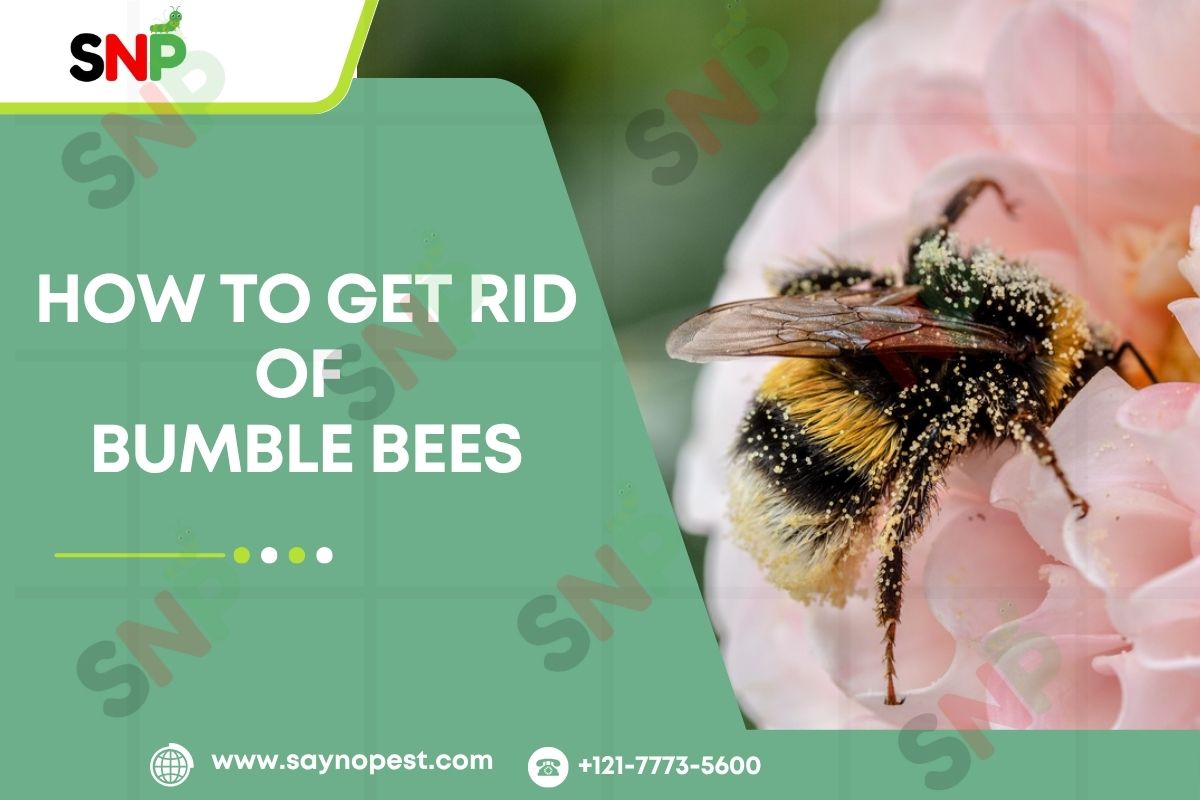
Bumble bees are a common insect in yards all over the United States, where they perform an important function as pollinators. They can be bothersome in two cases which are if their nest is located near your house and property, and the second one is when their nest is in an overcrowded area. This article will help you with the steps that attract them, their nature of existence, and both natural and chemical means of how to get rid of bumble bees, if you are still thinking about how to get rid of them safely and efficiently. Get more information from saynopest.
What Attracts Bumblebees

To learn about the ways of how to get rid of bumble bees, it is necessary to comprehend the factors that bring them to your property. The main things bumble bees are attracted to are:
- Flowering plants: The bumble bee has no special taste, and consequently during the early part of the season, the greatest number of bumble bees are captured in gardens where the variety of flowers in general, and those which fall within the sphere of blue and violet, e.g. lavender and grape hyacinth, is greatest. These colors show the presence of high nectar level which is unresistible to bumble bees
- Abundant pollen and nectar: Plenty of pollen and nectar. A yard that contains plants with a lot of flowers will ensure that there is a lot of food , and consequently, the place will be the best suits for bumble bees in order to establish their nests.
- Sheltered nesting spots: The bumble bee has the greatest tendency to build its nest underground, or somewhere that is cover up, like a compost pile, shed, or rodent hole that has fallen out of use.
In case you reduce the plant cover with flowering plants in the high-traffic areas and also cover the possible nesting sites, it will help you to maintain a low population.
Do Bumble Bee Cause Problem ?
Someone will always pose the question, Do bumble bee cause problem to the homeowners? Even though bumble bees are not significant and as dangerous as other stinging insects, they also sting when disturbed or when they believe that they are in some kind of defense of their nest. However, they may be a problem if:
- The nests are close to the doors or the area where the kids are playing: This therefore leads to a higher risk of the kids and the pets being affect by the bees without knowing and hence they can get stings without being aware of it, thus the conclusion that kids and pets are most at a risk here.
- Allergies: In case of those people who are very allergic to bee stings, a sting from even a single bee can be life-threatening for them.
- Structural concerns: Very few instances are that bumble bees could be the ones who cause damage caused by them to our constructions, as when their nesting place becomes wall voids or other structures, they may cause minor damage.
Nevertheless, bumble bees characteristically are great pollinators, but if they get close to humans, they become a threat, especially in case the nest is disturb.
Natural Ways on How to Get Rid of Bumble Bees

In case you want to act ecologically, there are even more natural solutions for the question of how to get rid of bumble bees without hurting them and the environment as well:
Essential oils
Aromas are, in general, peppermint, eucalyptus, cloves, and citronella, which are most repelling to bumble bees. A few drops of essential oil with water and a little bit of liquid soap in a spray bottle are mix, and then sprayed around the nesting places and the entry points.
Cinnamon and citrus
If we consider the use of a smelly substance as a deterrent for bumblebees, then the use of ingredients such as cinnamon and citrus smell would be of utmost importance; then we would distribute the above along the periphery of the registration area of these insects
Cucumber peels
If you put cucumber peels on aluminum plates near the places where bumble bees nest, you get an odor that is not pleasant for them.
Bee-repelling plants
Growing mint, neem, or citronella plants can be a natural way to get rid of bumble bees, as they will not come to your place to nest.
Chemical Treatments on How to Get Rid of Bumble Bees
If the infestation is very severe, you may have to resort to chemical treatments. Here is the guide on how to get rid of bumble bees with the means of chemicals:
Insecticidal dusts
Dow Baman is a product of the insecticidal dust family that utilizes the active ingredient deltamethrin. It is to used only for the nests of bees, wasps, and hornets, in the case of entry application, thus giving the effect of quick knockdown and residual control effect.
Aerosol sprays
Aerosols are a very efficient method when it comes to coats on surfaces that are non-porous, as they provide a fast and safe way of removing the undesired insects without them having the chance to hide. Although underground nests are less accessible and less effective with this method, as a rule of thumb, dust formulations are more suitable for bumble bees.
Professional grades concentration
There are no scents to these non-repellents concentrates, and they are the most effective in eliminating the bees which come into contact with them in the surface they are used in.
It is also notable to mention that reading label directions and observing a pest professional in case of allergy, or a nest in an inaccessible place are the precautions to observe before you begin this journey.
Conclusion
So, bumble bees are very good pollinators, but sometimes they can cause a lot of irritation to the people when their nest is located too close to your house and this could be harmful as well. Knowing what attracts the bumble bees, will help you to deal with them by following the best methods.
No matter if you went for natural repellents or chemicals, the main thing is to be safe and environmentally responsible. For more advice and ways to get rid of pests, go to saynopest—the one who helps you keep your house safe and free from pests.


