
Tag: How Long Do Chipmunks Live

  • What Do Chipmunks Eat? A Complete Guide to Diet, Habits

    What Do Chipmunks Eat? A Complete Guide to Diet, Habits

    Chipmunks are active and inquisitive rodents that inhabit the United States, and to successfully control pests and wildlife, it is important to understand their eating patterns. This blog discusses what do chipmunks eat, their wild food, concealment behaviors, traps, their life span, and how they seek shelter in residential places. Everything is legitimate, researched, and audience-specific to American readers, in a very interesting, informational, and sales-oriented format in the case of SayNoPest.

    Understanding What Do Chipmunks Eat

    The Chipmunks are omnivorous and thus which enables them to survive in diverse environments both in the wild and in the city. What chipmunks eat is a question that is answered in their versatility–the creatures eat a wide variety of food items based on what is around. The majority of their consumption is nuts, seeds, berries, plant bulbs, fungi, and grains. They always forage and fill their cheek pouches with food to take back to their burrows.

    what-do-chipmunks-eat

    Pet (and bird) food and garden fruits and vegetables left outside are common prey of chipmunks in residential areas. They also chew on tree bark, wooden buildings, and, when their favorite foods are not readily available, and thus they have become a common pest in American backyards. The foraging of chipmunks is opportunistic, and their search for nutrients brings them to urban and suburban areas.

    What Do Chipmunks Eat in the Wild

    Chipmunks change a lot in the wild depending on the season and the habitat in question. Nuts, seeds, berries, mushrooms, and the bulbs of different plants are the main forage of the wild chipmunks. They also consume insects, worms, bird egg and in some cases small frogs. During the fall, the chipmunks go out and gather food, which they hoard in their burrows to be consumed during the winter season when they are aware that the resources will be scarce.

    Wild chipmunks are most enterprising. They are able to carry many items at the same time in their cheek pouches and thus they gather non-perishable foods, e.g. hazelnuts, acorns and grains, very rapidly. Chipmunks are still great climbers even though they are very small and will climb low bushes and trees to reach nuts and seeds that are not on the ground.

    Chipmunk Traps: Managing Infestations

    Since they are flexible and consume a lot of food, chipmunks may become nuisances in the home environment, which is why many people become interested in using chipmunk traps to control them in the most humane and effective way. Good chipmunk traps should be effective and conscientious, and there are a few popular on the market that a homeowner can buy:

    • Live traps: Cage-style traps are helpful to capture and move chipped munks humanely. Peanut butter, sunflower seeds, or berries are some of the baits that chipmunks are attract to in the trap. They may be removed once they are caught as per the local ordinances.
    • Snap traps: This is a dangerous trap that is filled with foods that chipmunks feast on, like nuts or peanut butter. As useful as they are, snap traps are inhumane and need to placed with care to prevent harm exact on pets or animals, which are not target.
    • Electronic traps: Electric shocks are shocking devices powered by a battery. Electronic chipmunk traps are very convenient in the indoor environment and they reduce mess, however, they are expensive.
    • Bait tricks: The most effective chipmunk traps incorporate baits that mirror what do chipmunks feed on, nuts, berries, grains, and peanut butter.

    Regular checking of traps, placement of traps along major travel paths like near foundations, fences and driveways and proper use of traps should done to preserve non-target animals.

    How Long Do Chipmunks Live

    how-long-do-chipmunks-live

    The knowledge of the lifespan of chipmunks is important in terms of pest control or wildlife observation. Chipmunks usually live two to three years in the wild and this is because of predation, environmental hazards, and lack of food. Captive chipmunks that are not target by predators and extreme weather can live up to eight years.

    Chipmunks have a short life in nature which makes them always in search of food and shelter. They have a high rate of reproduction thus may cause a local population explosion when the environment is conducive and the food available sufficient.

    Conclusion

    In short, knowing the diet of chipmunks is the key to having a successful pest management and appreciation of wildlife. These versatile rodents feed on a wide variety of foods- nuts and seeds to tiny insects- and intelligently hoard food against the winter. Their cunning digging, concealing in houses, and their short life span are all a part of their survival tactics. The chipmunk traps, used strategically and attracting their favorite foods, will be a humane and practical way of controlling the chipmunks among American homeowners.

    To find quality, up-to-date pest control advice, useful tips, and the real truth about the behavior of chipmunks, call SayNoPest- where experience and service combine. Chipmunks can be very funny, but controlling their actions in and around houses keeps families safe and at ease throughout the United States.

    It is important to keep in mind that the first step into proper chipmunk management is knowledge, be inform and leave SayNoPest to lead you.
  • Discover How Long Do Chipmunks Live?

    Discover How Long Do Chipmunks Live?

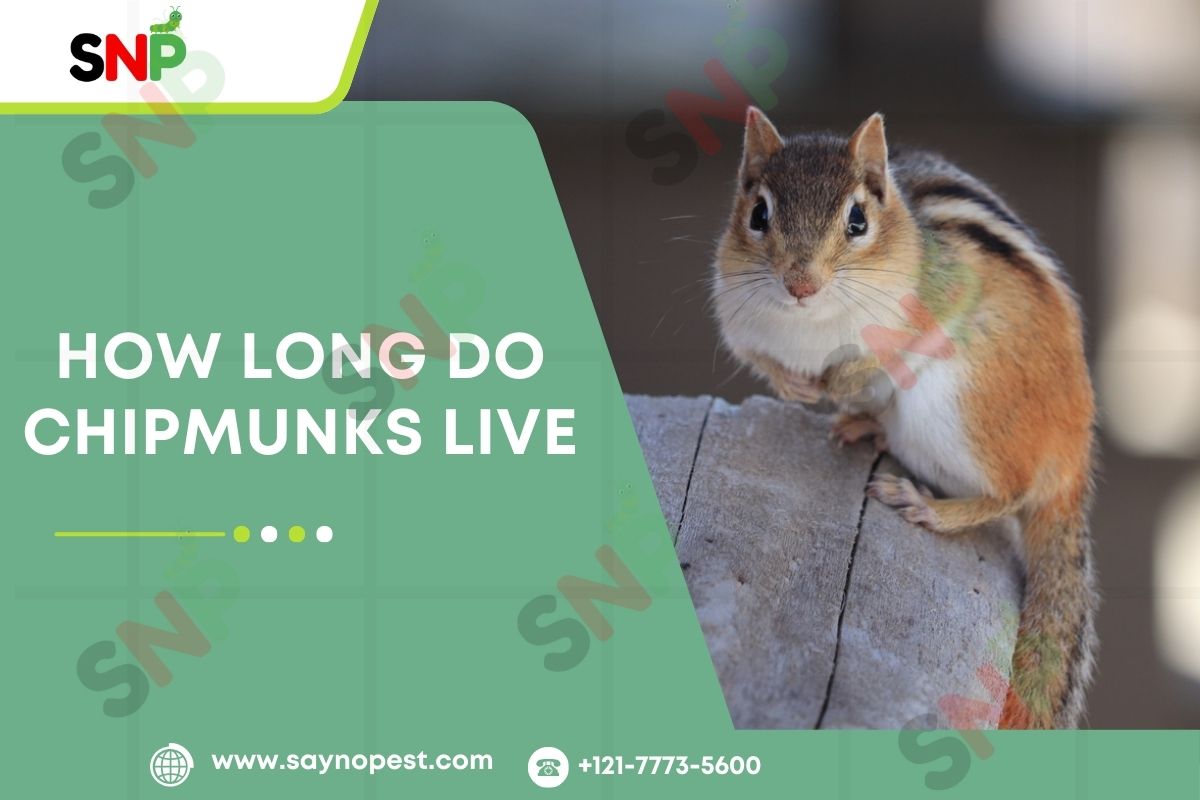
    Imagine the picture of a chipmunk, you might have a small, mark, busy creature, which is running all about the yard, or jumping on fences and trees. They may seem adorable, yet to thousands of homeowners across the United States, chipmunks may be considered a nuisance when they dig holes around foundations, destroy gardens, or raid the bird containers. This makes one ask the question: How Long Do Chipmunks Live? Their life cycle could be better understood in order to understand them better and to know how they should be handled. We will discuss the lifespan of the chipmunk in the wild and captivity, and in this blog, and how factors like the environment, predators, as well as seasons have significant contributions to the lifespan of this animal.

    Understanding the Lifespan of Chipmunks

    The chipmunk belongs to the family of the squirrel and is known for its special mark and smart living qualities. They are clever, resourceful, and active, though when alive, the life span of animals in the wild is sometimes extremely short because of natural difficulties.

    chipmunks-lifespan

    The main question- How Long do Chipmunks Live? can not be answered by a simple number since their life span is influenced by various factors. Hawks, foxes, coyotes, snakes, and even domestic cats are predators that cut their survival chances by a significant percentage. Moreover, unfavorable weather and human activity contribute to the reduction of the duration of their life in the open.

    It is also necessary to add that, as with the majority of those small mammals, the reproduction rate among chipmunks is quite high, and this fact guarantees the population of these creatures remains intact, even despite the shorter lifespan of certain animals. They can spot by homeowners, and this is due to the fact that they multiply at a very high rate, such that the species can guaranteed to thrive in both the urban and the rural areas.

    Average Lifespan of Chipmunks in the Wild

    To address the question How Long Do Chipmunks Live in their natural habitat: the average amount of the wild chipmunks that live in the wild is between 2 and 3 years. Theoretically, their bodies can sustain them till 8 years of age, but in practice, they rarely reach such an age.

    This is because the poor survival chances in the wild are largely attribute to the constant exposure to predators. A chipmunk is busy a great deal of his life foraging and storing food, making tunnels in the ground, and that is why he is at risk every time he comes out of his hole. Suburban neighbourhoods are also threaten by roads and cars daily. To make this worse, the severity of winters challenges their storage capacity for food and energy preservation.

    Baby chipmunks also have low rates of survival. Most of them fail to survive till maturity due to predators and environmental risks. After a chipmunk reaches its second year, the survival probability starts to decrease greatly, and this explains why the average wildlife span of it is quite short. This is also a consideration when discussing pest control–the chipmunks may not survive long on their own, but reproducing so rapidly, they are a thorn in the flesh.

    Do Seasonal Changes Impact Chipmunk Survival?

    Seasonal variations have one of the most outstanding contributions in the determination of How Long Do Chipmunks Live. Chipmunks do not hibernate in the way that true hibernators do, but rather, they go into a condition of torpor. This means that they are not asleep during the season and in fact, they sleep and take short intervals of wakefulness. Every few days they rise and eat the food which they have so carefully packed away in their underground rooms.

    This adaptation can help the chipmunks to save energy and even to live in the colder seasons. Still, it is more a question of how they managed to collect and accumulate food during the autumn that they survived or not. The chipmunk that did not manage to gain enough seeds, nuts and acorns might not make it through the winter.

    Deep snow or icy winter can cause chipmunks to bury in the snow, making it difficult to get food. On the other hand, hot, dry summers can cause food and water to be scarce, hence stressing the animal. Yes, therefore, seasonal changes do have a discernible impact on the life of the chipmunk, which tells us that their lives highly linked to the natural and even to personal readiness.

    How Long Do Chipmunks Live?

    The numbers are very different when we move the discussion towards How Long Do Chipmunks Live in Captivity. Chipmunks can seen to live a lifespan of between six to ten years without predators, bad weather conditions or the day-long stress of locating food.

    How-Long-Do-Chipmunks-Live

    Chipmunks are wild animals. They might seemgentle, but when they are kept in bad situations, they tend to be stressed, and this can have negative health effects. Wildlife laws may even ban the keeping of a wild chipmunk as a pet in a few states.

    Nevertheless, research findings of captive animals provide us with some information about the greatest possible lifespan of chipmunks under conditions of eliminating survival problems. They would live theoretically up to about a decade should they left free- much longer than they would have lived in the wild.

    Conclusion

    So, How Long Do Chipmunks Live? The life span of the wild chipmunks is 2-3 years in most instances, and it can extended in case such munks are exceptionally lucky or not attacked by predators. They can live as many as 6-10 years in prison, yet breeding groups, predatory instincts, environmental hazards, and food availability will never allow their life span to be long in the wild.

    The chipmunk life cycle is a way of not only appreciating the little mammal but also realizing why they become a common worry among house owners. The fact that their lifespan is rather short does not diminish their impact, as chipmunks multiply and adapt to the human world quite well. This implies that a garden or a yard can soon the dream place of a chipmunk unless preventative steps must taken.

    In case you have a chipmunk problem around your yard or house and you want expert guidance, then go to saynopest to find out how to solve the problem in the most efficient and environmentally friendly way. It is useful to know the life expectancy of the chipmunks, but it is more important to control the rodents before they inflict harm.