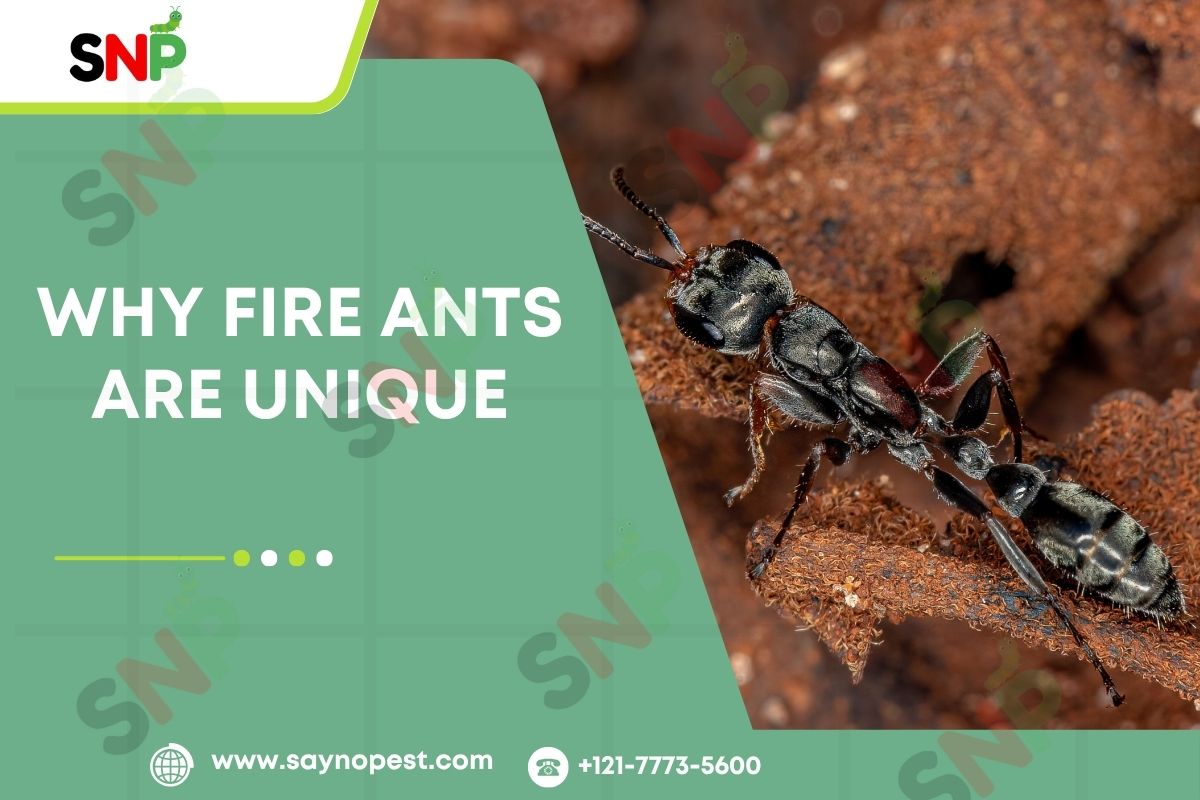
Fire ants have marched through southern and now increasingly temperate areas of the United States, transforming backyards and parks into minefields of stinging mounds. Why fire ants are unique begins with their biology: colonies contain over 200,000 workers, multiple queens, and a complex tunnel system that branches out up to 25 feet from every mound. They work so well together that when floods come along, the ants stick to one another to create living rafts, an accomplishment that reinforces why fire ants are unique among U.S pests. Throw in their handy venomous sting and attacking swarming behavior, and you can see why fire ants are distinctive dangers to humans, pets, livestock, and agriculture.
But their bite is also the same reason homeowners frantically search for answers. This guide demystifies what distinguishes their attack, how Fire ant bites react, the Symptoms and Causes of fire ant Bites, and most crucially How to treat fire ant bites quickly and safely.

Fire ant bites
When they’re disturbed, elves clamp mandibles into flesh and turn in a semicircle, injecting venom again and again. Technically the insects sting, but the painful papules that result are everywhere referred to as Fire ant bites. An individual ant stings repeatedly, and hundreds can strike within seconds. That flood-tide strategy explains why fire ants stand apart among all the ants in North America; fewer other species in that continent orchestrate such mass, repeated envenomation.
In most individuals, the first burn of Fire ant bites disappears within minutes, but itching soon replaces pain. Since so many ants sting in a tight arc, groups of tiny welts typically develop in characteristic semicircles. Left alone, these welts blister, then become filled with sterile pus within 8–24 hours, a classic indicator of Fire ant bites and one of the reasons Why fire ants are unique tormentors.
Symptoms and Causes of fire ant Bites
Symptoms and Causes of fire ant Bites start with solenopsin, the oily alkaloid component that constitutes over 95% of fire-ant venom. This chemical mix ignites immediate pain, localized redness, and swelling. Within a span of one hour, most victims get hive-like bumps; within 24 hours, the characteristic white pustule occurs in approximately 96% of cases. Identifying the Symptoms and Causes of fire ant Bites differentiates them from bee or wasp stings, which seldom cause sterile pustules.
In addition to skin responses, causes of fire ant Bites can get worse. As many as 6% of American adults form venom-specific IgE antibodies and have the potential for systemic symptoms like dizziness, tightness in the chest, or outright anaphylaxis. In severe people, hundreds of stings cause potentially life-threatening shock, again highlighting Why fire ants are special medical dangers.
The symptoms of fire ant Bites also differ with the number of stings. Ten single stings may cause localized swelling; 100 stings induce limb-wide edema; 1,000 stings jeopardize kidney damage and secondary infection. Early recognition of the Symptoms and Causes of fire ant Bites allows you to determine whether home care is sufficient or you need urgent assistance.
How to treat fire ant bites
Informed How to treat fire ant bites can save days of scratching and in extreme situations, a life.
Get away from the mound at once; slap ants off with your hand instead of washing, which excites them.
Use a cold compress 15 minutes on, 15 minutes off. This easy action is high on How to treat fire ant bites by minimizing swelling and discomfort.
Clean the area with water and soap. Maintaining the blister roof intact avoids infection, a fundamental principle in How to treat fire ant bites.
Employ over-the-counter 1% hydrocortisone cream or an oral antihistamine to suppress itching. Topical steroid strength is an established component of How to treat fire ant bites, particularly when developing large local reactions.
If pustules break from scratching, wash with an antiseptic and apply triple-antibiotic ointment; wound care is another foundation in How to treat fire ant bites.
Treat immediately medically for tongue or throat swelling, chest constriction, shortness of breath, or dizziness systemic manifestations that exceed home remedies for How to treat fire ant bites.
Physicians can include oral steroids in the case of extreme swelling of the limbs or epinephrine auto-injectors for individuals who have had anaphylaxis so they manage How to treat fire ant bites until EMS arrives.

Diagnosing fire ant bites
Rapid recognition affects comfort and How to treat fire ant bites. The most important identifiers are:
Groups of pustules in arcs or rings on feet, ankles, or hands—usual points of attack when walking on underground mounds.
A searing sting and after a few minutes, a raging itch, followed by a blistery swelling within a day.
Numerous tiny punctures in each of the pustules under close inspection, showing multiple stings instead of one puncture.
Once you know the Symptoms and Causes of fire ant Bites, such visual indicators simplify distinguishing them from mosquito bites or poison ivy. Knowing how to identify Fire ant bites quickly enables prompt first aid and avoids scratching that welcomes secondary infection.
Conclusion
From their rafts floating on the water to their stingers full of venom, each characteristic depicts Why fire ants are so special invaders of the United States. Their daring results in sore Fire ant bites, and knowledge of the Symptoms and Causes of fire ant Bites and expertise on How to treat fire ant bites gives families the power to remain safe outside. Keep in mind: rapid cooling, antihistamines, unbroken blisters, and urgent care for allergic reactions are the foundation of controlling Fire ant bites.
Whether you’re gardening, hiking, or just cutting the lawn, look for reddish mounds and be ready. With insight from saynopest, you can enjoy Why fire ants are amazing works of insect engineering while still giving them the boot when they encroach on your home.